
Complete Guide to GST Invoicing for Small Businesses
Learn how to create a GST invoice correctly—from mandatory fields and HSN/SAC codes to CGST, SGST, IGST, e-invoicing, input tax credit and record keeping—with clear examples for Indian businesses.
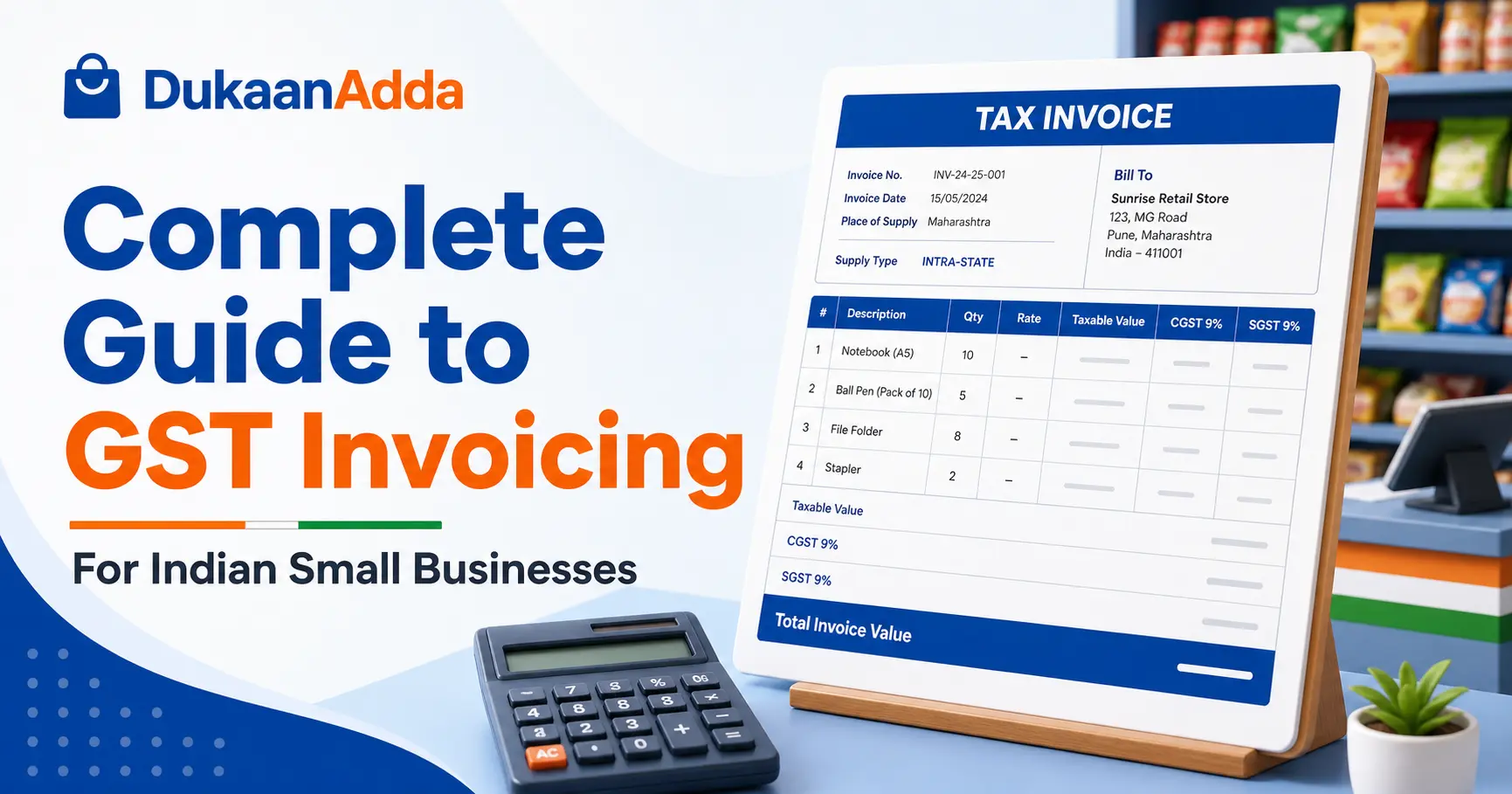
A customer asks for a “pakka GST bill.” What exactly should you print? Which GSTIN goes where? Should the bill show CGST and SGST, or IGST? Is a QR code compulsory? And does a PDF invoice count as an e-invoice?
These questions matter because an invoice is more than a payment receipt. It records the nature and value of a supply, supports the seller's tax reporting, helps an eligible buyer claim input tax credit (ITC), and creates the transaction trail that connects billing, stock and accounts.
This guide explains the practical foundation of GST invoicing for retailers, wholesalers, service providers and other small businesses in India. You will also see how a billing system such as DukaanAdda can reduce repetitive work without replacing the business owner's responsibility to use the correct GST registration, classification, tax rate and place of supply.
Important compliance note
In this guide
- 01What is a GST invoice?
- 02GST document types
- 03Mandatory invoice fields
- 04When to issue an invoice
- 05GST calculation with examples
- 06CGST/SGST vs IGST
- 07HSN, SAC and GST rates
- 08B2B, B2C and ITC
- 09E-invoicing and e-way bills
- 10Create a bill in DukaanAdda
- 11Correcting invoice errors
- 12Records and monthly compliance
- 13Common mistakes to avoid
- 14Frequently asked questions
01 · Basics
What is a GST invoice?
A GST tax invoice is the document issued by a registered supplier for a taxable supply of goods, services or both. It identifies the supplier and recipient, describes what was supplied, states the taxable value and shows the applicable tax rate and amount. Section 31 of the CGST Act provides the core obligation, while Rule 46 of the CGST Rules lists the required particulars.
A sales receipt, cash memo or payment confirmation may prove that money changed hands, but it is not automatically a valid GST tax invoice. Likewise, writing “GST included” on an ordinary bill does not make it compliant. The supplier must be entitled to collect GST, and the document must contain the prescribed details.
Seller record
Connects outward supply, tax liability and stock movement.
Buyer evidence
Supports eligible ITC along with the other legal conditions.
Audit trail
Links books, returns, payments, delivery and adjustments.
Can an unregistered business issue a GST invoice?
02 · Documents
Tax invoice, bill of supply and other GST documents
Using the correct document is the first compliance decision. Not every outward movement of goods needs a tax invoice, and not every correction should be handled by editing the original bill.
| Document | Typical use | Tax shown? |
|---|---|---|
| Tax invoice | A registered regular taxpayer makes a taxable supply. | Yes |
| Bill of supply | A composition taxpayer supplies goods/services, or a registered person makes an exempt supply. | No |
| Receipt voucher | A registered supplier receives an advance where the voucher requirement applies. | As applicable |
| Credit note | The original taxable value or tax was too high, goods are returned, or service is deficient. | Adjustment |
| Debit note | The original taxable value or tax was lower than it should have been. | Adjustment |
| Delivery challan | Goods move without a sale invoice in permitted cases, such as certain job-work or approval movements. | No |
An estimate or pro forma invoice is also different from a tax invoice. It can communicate a proposed price, but should be clearly labelled and should not be treated as proof that the taxable supply has already been invoiced.
03 · Format
Mandatory fields in a GST tax invoice
There is no single compulsory visual design for every small business invoice. You may use A4, A5, thermal paper or a digital PDF, provided the document is readable and contains the particulars required for your supply. The following checklist covers the core Rule 46 fields in practical language.
Supplier details
Legal or trade name, complete address and GSTIN of the supplier.
Unique invoice number
A consecutive serial number, unique for the financial year and not longer than 16 characters.
Invoice date
The date on which the tax invoice is issued.
Recipient details
For a registered buyer: name, address and GSTIN or UIN. Additional rules apply to unregistered buyers.
HSN or SAC
The applicable HSN code for goods or SAC for services, with the required number of digits.
Item description
A clear description of each good or service supplied.
Quantity and unit
Quantity and unit or Unique Quantity Code for goods, wherever applicable.
Total and taxable value
Gross value plus the taxable value after eligible invoice-level discount or abatement.
GST rate and amount
Rate and amount of CGST, SGST/UTGST, IGST and cess, shown separately as applicable.
Place of supply
State name and code for an inter-state supply, plus delivery address when it differs.
Reverse-charge status
A clear indication of whether tax is payable under reverse charge.
Authentication
Signature or digital signature where applicable; notified e-invoices also require the IRN-linked QR code.
Do not confuse the two QR codes
For an unregistered recipient, buyer details become especially important when the taxable supply reaches the prescribed value. Rule 46 also addresses cases below that value when the customer asks for the details to appear. Your invoice should additionally show the delivery address where it differs from the recipient address.
For small-value retail supplies below ₹200 to an unregistered customer, an individual tax invoice may be omitted only when the legal conditions are satisfied and the customer does not request one; the supplier must follow the consolidated end-of-day invoice rule. Treat this as a narrow operational exception—not permission to skip sales records.
04 · Timing
When should a GST invoice be issued?
The invoice date affects tax reporting, the buyer's credit trail and the sequence of your records. The general timing depends on whether you supply goods or services:
Supply of goods
Where movement is involved, issue the invoice before or at removal for supply. Where movement is not involved, issue it before or at delivery or when the goods are made available.
Supply of services
Issue the invoice before or after providing the service, but generally within 30 days from the date of supply. A 45-day period applies to specified financial-sector suppliers.
Continuous supplies, goods sent on approval, advances, reverse charge and certain notified sectors have additional rules. Configure your normal billing process around the general rule, then document exceptions separately with your accountant.
05 · Calculation
How to calculate GST on an invoice
Start with the taxable value. In a simple tax-exclusive sale, multiply the taxable value by the applicable GST rate.
GST amount = Taxable value × GST rate ÷ 100
Invoice total = Taxable value + GST + cess (if any) + other valid charges
Example A: intra-state sale at 18%
A Patna retailer sells taxable goods worth ₹10,000 to a customer in Bihar, and the legal place of supply is Bihar. Assuming an 18% rate and no cess:
Example B: inter-state sale at 18%
The same ₹10,000 taxable supply is made from Bihar and the legal place of supply is Jharkhand. In the straightforward inter-state case:
Example C: price already includes GST
If the customer price is ₹1,180 inclusive of 18% GST, calculate the embedded tax rather than adding another 18%:
Taxable value = ₹1,180 × 100 ÷ 118 = ₹1,000
GST = ₹1,180 − ₹1,000 = ₹180
Apply discounts consistently. A discount known before or at the time of supply and recorded on the invoice generally reduces taxable value. Post-supply discounts require additional conditions before they can reduce GST. Rounding should happen through a consistent accounting rule; avoid manually changing tax figures merely to force a preferred grand total.
06 · Tax split
CGST + SGST or IGST? Use the place of supply
The popular shortcut—“same state means CGST and SGST, different state means IGST”—is useful only after you correctly determine the supplier location and legal place of supply.
| Comparison | Typical tax | Invoice display at 18% |
|---|---|---|
| Supplier state = place-of-supply state | Intra-state | CGST 9% + SGST/UTGST 9% |
| Supplier state ≠ place-of-supply state | Inter-state | IGST 18% |
The customer's state is not always the answer
07 · Classification
HSN codes, SAC codes and GST rates
HSN (Harmonised System of Nomenclature) classifies goods. SAC (Services Accounting Code) classifies services. The code helps determine reporting requirements and supports the applicable tax classification—but a familiar product name alone is not enough. Composition, packaging, usage and notifications can change the result.
Preceding FY turnover above ₹5 crore
6 digits
HSN/SAC required on invoices under the CBIC guidance effective 1 April 2021.
Preceding FY turnover up to ₹5 crore
4 digits
Generally required on B2B invoices; check current notification and portal requirements for your transaction.
Common GST slabs include 0%, 5%, 12%, 18% and 28%, and some supplies also attract cess or special rates. Do not choose a rate merely because a similar item uses it. Maintain a verified item master containing the item name, HSN/SAC, unit, tax rate, cess and whether the sale price is inclusive or exclusive of tax. Record who approved each classification and when it was last reviewed.
A safer product-master habit
08 · Customer type
B2B, B2C and input tax credit
A B2B invoice is issued to a registered recipient and should capture the buyer's correct GSTIN and registered details. A B2C invoice is issued to an unregistered customer. This distinction affects invoice data and return reporting; it does not by itself decide whether the supply is intra-state or inter-state.
Before finalising a B2B invoice
- Validate the customer's 15-character GSTIN and legal name against the information they provide or the GST portal.
- Confirm billing address, delivery address and place of supply separately.
- Ensure the invoice is reported under the correct recipient GSTIN and document number.
- Reconcile outward invoices with return data before filing.
A buyer cannot rely on a neat-looking PDF alone to claim ITC. The recipient must hold the prescribed document and satisfy the other Section 16 conditions, including eligibility, receipt of goods or services, supplier reporting and applicable return and payment requirements. Businesses should reconcile purchase invoices with the portal statement communicated to them and follow up on missing or mismatched documents.
09 · Digital compliance
E-invoicing and e-way bills: what small businesses should know
“Invoice made on a computer,” “PDF invoice” and “e-invoice” do not mean the same thing. Under the GST e-invoicing system, the notified supplier first creates the invoice in its billing or accounting system, reports the prescribed data to an authorised Invoice Registration Portal (IRP), and receives an Invoice Reference Number (IRN) plus a digitally signed QR code.
Current broad threshold
AATO exceeding ₹5 crore
The mandate generally applies to notified registered persons whose aggregate annual turnover exceeded ₹5 crore in any preceding financial year from 2017-18 onward, for covered transactions such as B2B and export supplies. Entity and transaction exclusions apply, so turnover alone is not the complete test.
From 1 April 2025, taxpayers with AATO of ₹10 crore or more are subject to a 30-day limit for reporting covered e-invoice documents from the document date on the IRP. If this rule applies to you, old documents outside the allowed window may be rejected by the portal. Confirm later advisories before relying on the limit.
What about an e-way bill?
An e-way bill relates to movement of goods; an e-invoice authenticates specified invoice data. One does not automatically replace the other. E-way bill requirements generally become relevant when the consignment value exceeds ₹50,000, but exceptions, state rules and movement types matter. Check the e-way bill portal requirements before dispatch.
Practical rule
10 · DukaanAdda
How to create a GST invoice in DukaanAdda
DukaanAdda brings billing, inventory and customer records together on Android and Windows. A disciplined setup can make day-to-day GST billing faster while keeping the invoice data consistent.
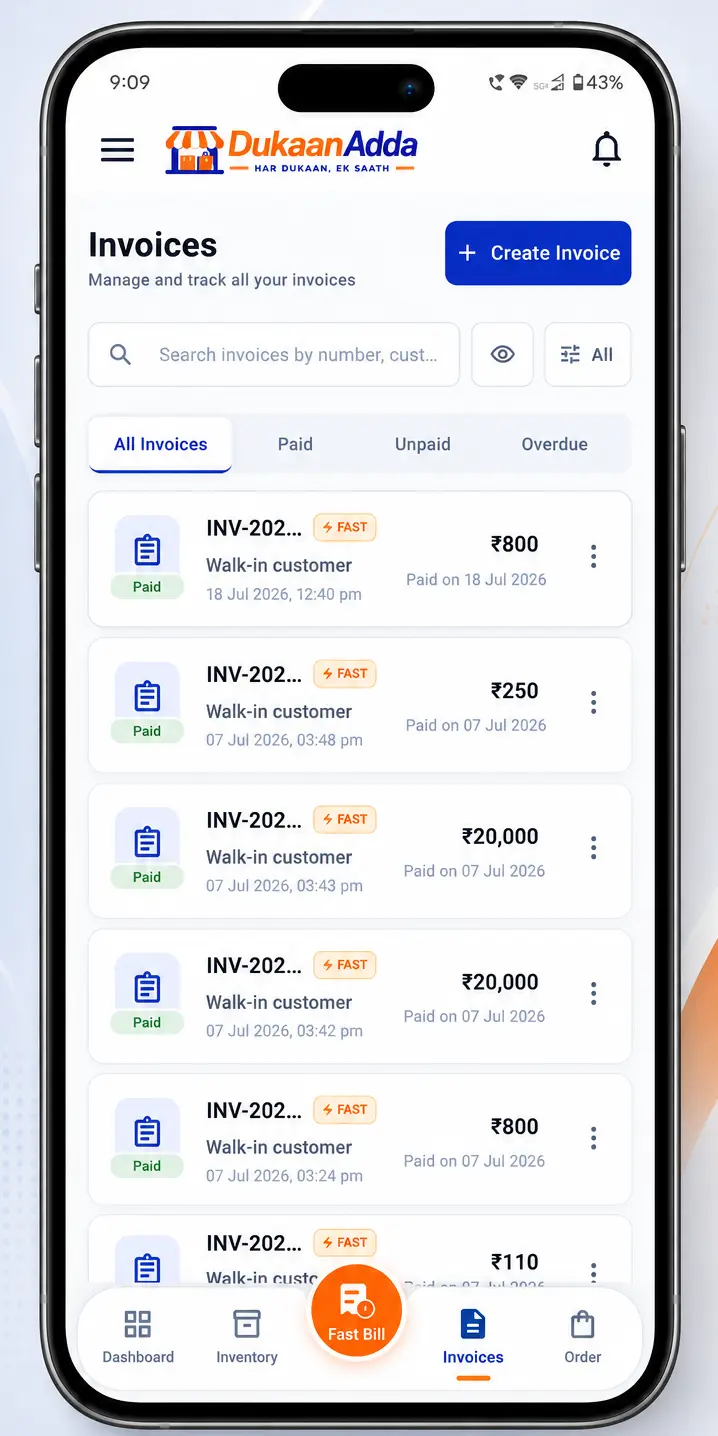
Set the data once. Reuse it carefully.
Store verified product, tax and customer details so each bill begins with consistent master data. Always review the transaction facts before finalising.
Explore billing features- 1
Complete the business profile
Enter the correct business name, GSTIN, registered address, state and invoice preferences. Match them with your registration certificate.
- 2
Build a verified item master
For every product or service, confirm description, HSN/SAC, unit, GST rate, cess if any, and whether the selling price includes tax.
- 3
Select or create the customer
For B2B sales, capture the buyer's legal name, GSTIN and billing address. Keep delivery address and place of supply available separately.
- 4
Add items and commercial adjustments
Enter quantities, prices and eligible discounts. Confirm that the taxable value is calculated from the agreed commercial terms.
- 5
Check the tax split
Verify whether the supply should show CGST plus SGST/UTGST or IGST. Do not rely on automation when the transaction has unusual place-of-supply facts.
- 6
Preview before finalising
Check invoice number, date, GSTINs, HSN/SAC, taxable value, tax rate, tax amounts, rounding and grand total.
- 7
Share, print and preserve
Provide the invoice as a PDF or print, use a supported thermal-print workflow where appropriate, and retain a backed-up electronic record.
Automation helps; verification remains yours
11 · Adjustments
How to correct an invoice mistake
First decide whether the invoice is still a draft or has already been issued, shared, reported or used for delivery. A draft can generally be corrected before finalisation. Once issued, preserve the original document and its sequence.
Taxable value or tax charged too high
A credit note may be appropriate, subject to the facts, time limits and reporting rules.
Taxable value or tax charged too low
Issue a debit note or supplementary invoice as applicable and report the additional liability correctly.
Goods returned or service deficiency
Link the credit note to the original invoice and maintain the supporting return or service records.
Wrong customer GSTIN or place of supply
This can affect tax type and return reporting. Escalate to your accountant instead of simply editing the PDF.
Do not reuse an old invoice number, renumber issued invoices to hide a gap, or overwrite the only stored copy. A cancelled number should remain visible in the audit trail with its status and reason.
12 · Routine
Record keeping and a monthly GST invoice checklist
GST compliance becomes easier when invoice review is a routine, not a last-day filing exercise. Registered persons generally need to preserve relevant accounts and documents for 72 months from the due date of the annual return for the year. Proceedings or investigations can extend the retention period.
Keep these records connected
- Sales invoices and bills of supply
- Purchase invoices and ITC reconciliation
- Credit notes and debit notes
- Delivery challans and e-way bills
- Advances and related vouchers
- Stock movement and item ledgers
- Payment references and customer ledgers
- Electronic backups and audit trail
Month-end review in 10 checks
- 1.Confirm invoice numbers are unique, chronological and explained where cancelled.
- 2.Match total outward invoices with sales and payment records.
- 3.Review GSTIN validation failures and customer master changes.
- 4.Scan for incorrect CGST/SGST versus IGST treatment.
- 5.Check negative quantities, unusual rates, zero tax and manual overrides.
- 6.Reconcile credit/debit notes with their original invoices.
- 7.Review HSN/SAC and rate changes applied during the month.
- 8.Confirm required e-invoices received an IRN and signed QR code on time.
- 9.Reconcile purchase invoices and eligible ITC with portal data.
- 10.Export a backup and verify that the file can actually be restored.
13 · Prevention
Common GST invoicing mistakes to avoid
Using the wrong or inactive GSTIN
Better: Validate business and B2B customer details, then lock approved master fields against casual edits.
Treating customer state as place of supply
Better: Capture supplier location, billing address, shipping address and place of supply separately.
Showing CGST, SGST and IGST together
Better: For an ordinary line item, apply the correct intra-state split or IGST treatment—not both.
Missing or guessed HSN/SAC
Better: Use a reviewed product master and document the classification source.
Breaking the invoice sequence
Better: Use a financial-year series, preserve cancelled numbers and never silently reuse them.
Calling every PDF an e-invoice
Better: Where the mandate applies, obtain the IRN and signed QR code from an authorised IRP.
Editing issued bills without an audit trail
Better: Use documented cancellation, credit-note or debit-note workflows based on the facts.
No reliable backup
Better: Keep restorable electronic backups and retain records for the applicable legal period.
14 · FAQs
Frequently asked questions about GST invoices
1. Who can issue a GST tax invoice?
A GST-registered regular taxpayer can issue a tax invoice for a taxable supply. An unregistered business must not collect GST or present its bill as a GST tax invoice. A composition taxpayer generally issues a bill of supply instead of collecting GST separately.
2. Is a GSTIN compulsory on every invoice?
The supplier's GSTIN is compulsory on a GST tax invoice. The recipient's GSTIN or UIN is required when the recipient is registered. For an unregistered recipient, the applicable name, address, delivery and state-code requirements depend on the value and facts of the supply.
3. What is the difference between CGST, SGST and IGST?
For an intra-state supply, GST is generally split into CGST and SGST or UTGST. For an inter-state supply, IGST generally applies. The correct result depends on the supplier location and the legal place of supply, not only the customer's postal address.
4. Can I edit or delete a GST invoice after issuing it?
Avoid silently overwriting or deleting an issued invoice. Preserve the audit trail and use the appropriate cancellation process, credit note, debit note or other permitted correction based on the situation and return-reporting status.
5. Is a UPI QR code mandatory on every GST invoice?
No. A payment QR code is useful but is not a universal mandatory field on every GST invoice. A notified e-invoice has a specific IRN-linked signed QR code, which is different from a UPI payment QR code. Separate dynamic QR rules may apply to notified classes of B2C suppliers.
6. Is a digital or PDF invoice valid?
GST records and invoices may be maintained electronically, subject to the applicable rules and reliable authentication, accessibility and backup. A PDF created by billing software is not automatically an e-invoice; e-invoicing requires reporting to an Invoice Registration Portal and receiving an IRN and signed QR code when the mandate applies.
7. When is e-invoicing mandatory for a small business?
The current mandate generally covers notified registered persons whose aggregate annual turnover exceeded ₹5 crore in any preceding financial year from 2017-18 onward, subject to transaction-level rules and entity exclusions. Businesses should verify their status on an authorised Invoice Registration Portal and check later notifications.
8. How many HSN digits should be printed on an invoice?
CBIC guidance effective from 1 April 2021 requires six-digit HSN or SAC for taxpayers with turnover above ₹5 crore in the preceding financial year. Taxpayers up to ₹5 crore generally use four digits on B2B invoices. E-invoice systems and specific notifications can require more detail, so verify the current rule for your case.
9. How long should GST invoices be kept?
Section 36 generally requires records to be retained for 72 months from the due date of the annual return for the relevant year. If an appeal, proceeding or investigation continues, records may need to be kept longer.
10. Does a correct invoice guarantee input tax credit?
No. A valid invoice is important, but the recipient must also satisfy the other conditions under GST law, such as receipt of the supply, eligible credit, supplier reporting and applicable return and payment conditions. Reconcile purchase records with portal data and consult a tax professional for disputed credit.
Make every invoice easier to check
Use DukaanAdda to keep billing, products, customers, inventory and business records connected across Android and Windows. Start with accurate master data, verify each transaction and keep your accountant in the review loop.
Official references used for this guide
Use these primary sources to confirm the rules and check for later amendments or advisories: